By Patty de Llano, Business Development Manager of Public Policy & Funding
Following the 2025 funding pause, revised FHWA guidance, and a January 2026 federal court ruling, states are again moving forward with NEVI implementation, although progress varies significantly by state. Funds are accessible, and new guidance has loosened site-placement rules. That latter change is the kind that will allow Wyoming, for example, to place chargers along the routes from California to its national parks, instead of arbitrary highway mile markers.
Congress set aside an initial $4.4 billion for NEVI charging stations, yet states have managed to get reimbursed for just $94 million, and some states have yet to spend a dollar. That gap isn’t just due to political friction or a funding freeze hangover, though both play a part. Much of it comes down to paperwork.
What Does NEVI “Compliant” Really Mean?
Purchase orders might look clean on submission but get kicked back over a documentation gap. Among the most common errors is Buy America compliance. Site hosts often treat a vendor’s “compliant” claim as a fixed fact that applies to every future order. But it isn’t. Compliance is calculated per hardware configuration, so it must be verified purchase order by purchase order, not based on an assumption.
Federally funded charging programs such as NEVI are subject to Buy America requirements, while state and utility programs may apply their own domestic-content, technical, and administrative requirements. States can impose requirements or scoring criteria beyond the federal minimums. Getting that layering backward carries an actual cost: assuming a state’s approval satisfies the federal threshold, or the reverse, can send a clean-looking purchase order back for a documentation request that adds weeks or months to the timeline.
This is also where the expanded placement flexibility mentioned above comes in. NEVI’s evolving requirements are often described as “loosening,” but that is not quite accurate. Site eligibility no longer hinges as rigidly on direct highway adjacency, for example, while newer medium- and heavy-duty charging programs have introduced their own new requirements, like large-lot minimums to accommodate trailers. States are administering the program more specifically than they were two years ago, not with less oversight.
NEVI’s Core Hardware Requirements
The National Electric Vehicle Infrastructure Formula Program allocates $5 billion over five years to build highway-corridor charging. For a station to qualify, FHWA guidance requires a minimum of four ports per site, each capable of delivering at least 150 kW, along with a station uptime requirement (commonly cited at 97 percent or higher) and CCS connector support. States administer NEVI funds individually and can layer additional requirements, so a configuration approved in one state’s solicitation is not automatically approved in another’s.
Keep in mind that federal guidance has been revised more than once since 2022, and a federal court order in January 2026 reinstated NEVI funding after a temporary freeze, so administration is actively in motion. Internal estimates suggest only a fraction of total allocated NEVI funds have been disbursed so far, and state progress varies widely — some states are processing later funding rounds while others have not yet opened their first.
Buy America for EV Chargers: What Domestic Content Actually Requires
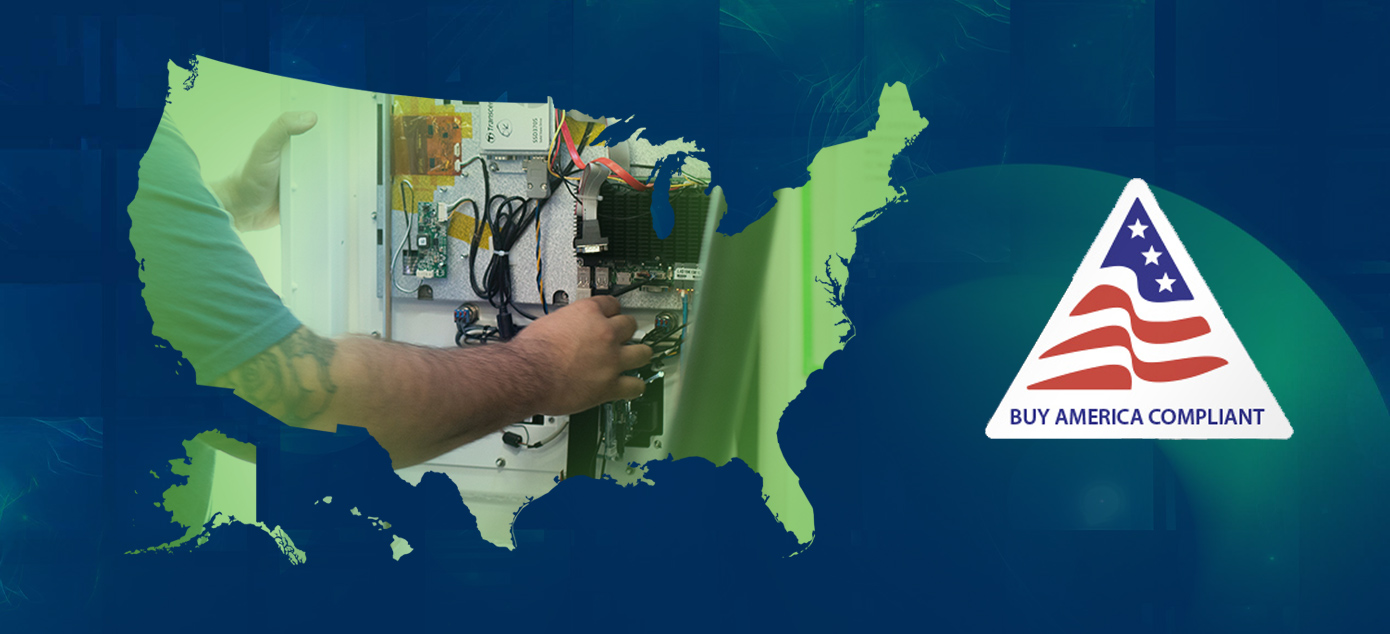
The FHWA requirement states that the cost of components manufactured in the United States must be at least 55% of the cost of all components, with final assembly occurring in the U.S. A proposal to increase this to 100% is under consideration.
The current 55% threshold remains in effect, but federally funded projects with future procurement dates should monitor a recently proposed modification closely.
BTC POWER offers Buy America compliant configurations built to the current requirements and continues to monitor proposed changes to the federal domestic-content threshold.
Common NEVI Compliance Mistakes That Delay Funding
The mistakes that stall applications tend to repeat: assuming a vendor’s Buy America marketing claim covers the specific unit being purchased; failing to confirm final assembly location in writing before the PO is signed; overlooking that a state’s NEVI plan has requirements beyond the federal minimum (CALeVIP 2.0 is a case in point); and citing a vendor’s uptime claim without confirming how that number was measured.
A charger that’s reliable in the field but reports uptime using a different methodology than the funding program expects can create a documentation gap, not a hardware problem, but it still delays the check. (See our earlier look at what Buy America compliance means for EV charger infrastructure for a deeper walkthrough of how the domestic content rules apply component by component.)
A related and common mistake happens earlier than any of these: funding conversations often start as an afterthought, once a site host is already focused on equipment pricing rather than site eligibility. Bringing funding navigation into the conversation at the site-selection stage, rather than after equipment specs are set, prevents most of the delays detailed above — the same principle applies whether the funding source is NEVI, CALeVIP, or a cooperative purchasing pathway like the 791 Purchasing Cooperative, which runs its own vendor-approval timeline separate from the compliance requirements the hardware itself must still meet.
How BTC POWER’s Irvine Facility Supports NEVI-Eligible Projects
BTC POWER’s Irvine, California facility is a Buy America production facility, and it’s the company’s headquarters, not a branch or contract site, a distinction worth noting since some site hosts assume from the name alone that BTC POWER is a foreign manufacturer with a US satellite office. It’s the reverse: Irvine is headquarters, engineering, and production, all in one place, and has been since the company entered the category.
The Gen 4 AiO and DC Split System lines built there include NEVI-compliant configurations.
Because funding navigation is a named role at BTC POWER rather than a side function of sales, site hosts working through NEVI, CALeVIP, or cooperative-purchasing pathways can get configuration-specific compliance confirmation as part of the buying process, not as an afterthought once the application is already in motion.
Building Compliance Into the RFP, Not Discovering Gaps After
The site hosts who avoid funding delays are the ones who write these requirements into their RFP language before a vendor is selected, not the ones who trust a logo on a product page. Before signing a purchase order tied to federal or state funding, ask each vendor for:
- A domestic content certification specific to the exact model and power configuration being purchased
- Written confirmation of final assembly location
- Documentation of how uptime figures were calculated, and over what operational period
- The vendor’s position on the pending FHWA waiver modification, since a vendor that can already meet a higher domestic content threshold is a safer bet if the requirement moves
Ask these questions before the RFP closes, not after the equipment ships. With the Buy America threshold for EV chargers currently under federal review, that verification step matters more this year than it did last year, not less.
BTC POWER’s funding and policy team can confirm your configuration against domestic content, final assembly, and NEVI/CALeVIP requirements before it’s on a purchase order, not after. Talk to our funding team.
FAQ: NEVI and Buy America Compliance
What happens if a NEVI-approved charger configuration changes after approval?
Any change to the model, power output, or component sourcing can affect Buy America compliance, since compliance is verified per hardware configuration rather than per vendor. Site hosts should re-confirm compliance whenever a specification changes, rather than assuming the original state approval still applies.
Does a vendor’s Buy America claim cover every charger they sell?
No. Buy America compliance is calculated per hardware configuration, not company-wide. A single vendor can have both compliant and non-compliant models, so site hosts should request a domestic content certification for the specific model and power configuration being purchased.
How is EV charger uptime measured for NEVI compliance?
NEVI funding requires a minimum station uptime, commonly cited at 97 percent or higher, but vendors can calculate uptime using different methodologies. Site hosts should ask how a vendor’s uptime figure was calculated and over what period, since a methodology mismatch can delay funding even when the hardware itself performs reliably in the field.
About the Author: Patty de Llano