
Twenty years ago, businesses debated whether to offer free Wi-Fi to their customers. Today, that debate sounds absurd. Commercial EV charging stations, while not always free, are becoming essential. The industry segment is witnessing a similar shift, and that shift is happening faster than most people realize. We have the data to illustrate this.
BTC POWER surveyed over 200 commercial EV charging decision-makers across six industries in late 2025, and the results make one thing unmistakably clear: the conversation has moved from ‘if’ to ‘when’ and ‘how.’ Organizations are asking how to do it right, who to trust, and how to avoid the mistakes that leave other programs struggling.
One of the most surprising findings? The results reveal a market that has quietly, confidently matured, even amid headlines about federal funding uncertainty and economic jitters. Let’s dive in.

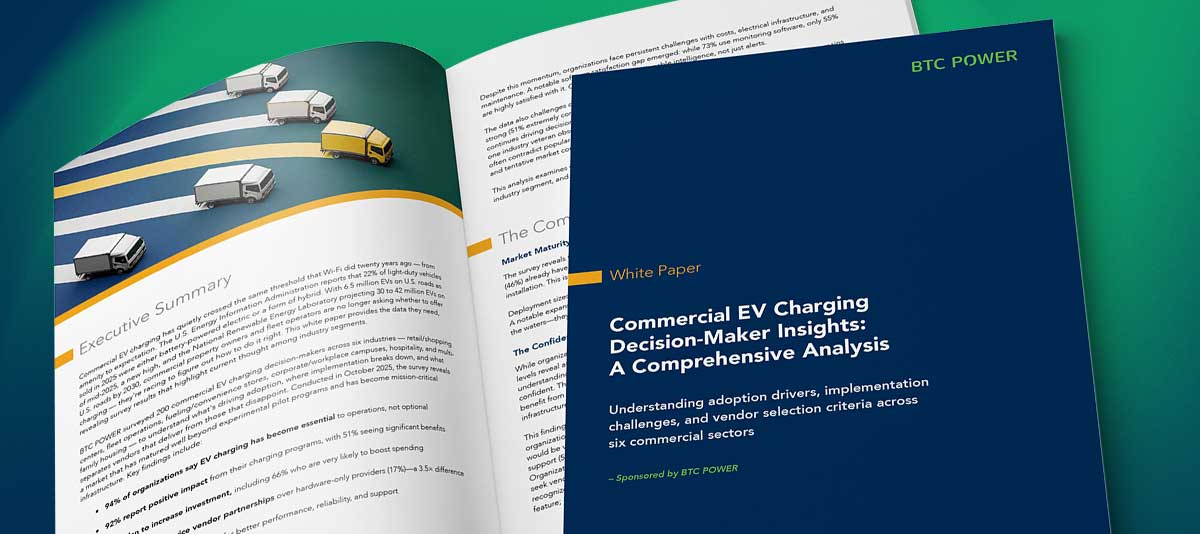
White Paper
Commercial EV Charging Decision-Maker Insights
A Comprehensive Analysis
The Numbers Tell the Story: Commercial EV Charger Stations are Part of the Commercial Landscape
Of the 200 decision-makers surveyed, 94% say EV charging stations have become essential to operations. Not a perk. Not a pilot program. Essential infrastructure. And 92% report positive business impact from their programs, with 51% describing those benefits as significant.
More telling still: 97% plan to increase EV charging investment. Only 3% are unlikely to boost spending. That’s not the behavior of businesses hedging their bets. These industries go beyond parking lots and gas stations. They span:
- Retail and shopping centers
- Fleet operations
- Fueling and convenience stores
- Corporate and workplace campuses
- Hospitality
- Multi-family housing developments
What’s Actually Driving Commercial EV Charger Adoption
Ask most people what’s pushing commercial EV chargers forward, and they’ll say government incentives. The survey data tells a more nuanced story. The top two adoption drivers are tied at 46% each; meeting sustainability goals and meeting customer and employee demand. Private investment, not public subsidy, is increasingly funding new installations.
Policy confidence remained strong even during a period when federal NEVI funding faced temporary uncertainty. Among organizations with commercial EV chargers already installed and operational, 67% said they were extremely confident in the long-term policy environment. The takeaway? Those with real-world EV installation experience understand that federal funding is one layer in a much deeper ecosystem that includes state programs, local incentives, and straightforward business ROI.
Where Programs Break Down
Success isn’t automatic just because you’ve installed a commercial EV charger. The organizations struggling most share a common pattern: they treated EV installation as a hardware purchase rather than an infrastructure investment.
One of the most surprising findings? The results reveal a market that has quietly, confidently matured, even amid headlines about federal funding uncertainty and economic jitters.
High upfront costs (49%), complicated permitting (37%), and limited electrical infrastructure (35%) are the top pre-installation concerns. Post-installation, those same issues don’t disappear. They’re joined by high maintenance requirements (32%), charging speeds that fall short of expectations (31%), and reliability and uptime problems (22%).
The organizations navigating these challenges most effectively aren’t the ones who found the cheapest hardware. They’re the ones who found the right partner.
The EV Charger Software Problem No One Is Talking About
Installing a commercial EV charger is one thing. Getting useful intelligence out of it is another. Yet most organizations aren’t there yet.
The survey uncovered a striking gap that deserves more attention: 73% of commercial operators use monitoring software for their EV chargers, but only 55% are highly satisfied with it. That’s an 18-point gap, and it repeats across every software function measured. Energy management: 59% use it, 43% are highly satisfied. Data and reporting: 58% use it, 45% are satisfied. Billing and payment: 58% use it, 46% are satisfied.
The problem isn’t adoption. It’s value delivery. Most current software does the equivalent of turning on a check engine light; it tells you something is wrong without explaining what it means, what the operational impact is, or what to do next. Decision-makers don’t need more alerts. They need answers.
The data reinforces this: organizations that are highly satisfied with their overall EV charger performance are significantly more likely to have robust data, reporting, and energy management software in place. Better software integration correlates directly with better outcomes. For operators evaluating vendors, the question shouldn’t just be “what hardware do you offer?” It should be “what does your software actually tell me?”
The Commercial EV Charger Partnership Shift
This is perhaps the most important finding in the entire survey: when asked about preferred vendor relationships, 60% of decision-makers want a full-service partner from planning through ongoing support. Only 17% prefer a hardware-only provider. That’s a 3.5-to-1 margin.
The market has moved well beyond transactional equipment sales. Organizations want vendors who understand permitting, can optimize electrical infrastructure, provide proactive maintenance, and offer software that does more than turn on a warning light. They want answers, not just alerts.
And they’re willing to act on that preference. Despite reporting high overall satisfaction, 52–58% of organizations say they would switch vendors for better performance, reliability, or support. High current satisfaction and high switching intent aren’t contradictory. They reflect a market where decision-makers know what good return looks like and are actively searching for it.
White Paper
Commercial EV Charging Decision-Maker Insights
A Comprehensive Analysis
What This White Paper Covers
Our full goes deep on all of it: the specific priorities and pain points across all six commercial sectors, the software satisfaction gap that’s creating a new competitive frontier, the innovation drivers that will shape expansion decisions, and the vendor selection criteria that separate programs that thrive from those that don’t.
If you’re responsible for EV charging decisions at a commercial property, fleet operation, or any of the six sectors covered in this research, this is the data you’ve been waiting for to help make decisions that can positively influence your purchasing path. Download the full report.
- What is driving commercial EV charging adoption? The top drivers of commercial EV charging adoption are two related factors: the desire to meet sustainability goals and to fulfill customer/employee demand. Each reason was cited by 46% of decision-makers in a recent major industry survey conducted by BTC POWER.
- What are the biggest challenges of installing commercial EV chargers? The biggest challenges in installing commercial EV chargers include high upfront costs, complex permitting, and limited electrical infrastructure, followed by post-installation issues such as maintenance demands and reliability problems.
- How do I choose the right commercial EV charger vendor? You can choose the right EV charging vendor, first of all, by looking beyond hardware. Most decision-makers want a full-service partner covering planning, permitting, and ongoing support, and prioritize vendors whose software delivers actionable insights, not just alerts.
Dive into a comprehensive look at where commercial EV chargers are in today’s environment with the white paper, Commercial EV Charging Decision-Maker Insights: A Comprehensive Analysis. You might be surprised by what you find.