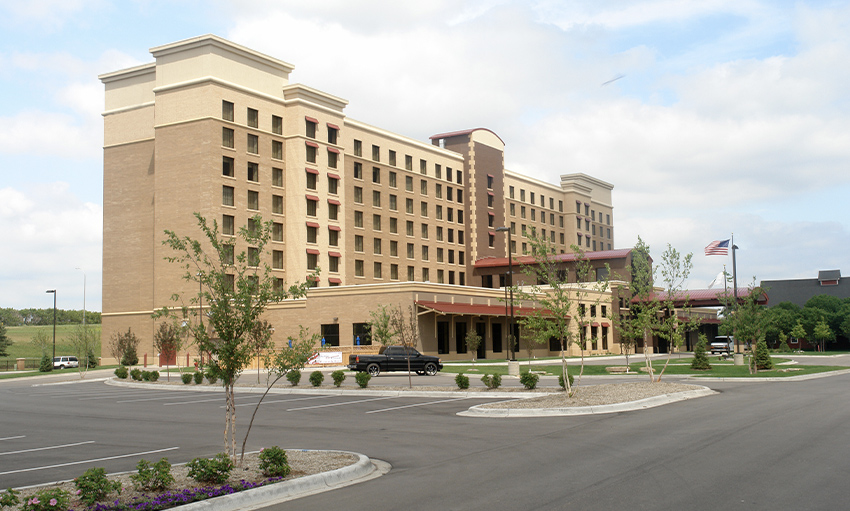
Drive booking selections and create potential new revenue streams by adding a highly desired utility to your list of featured amenities: electric vehicle charging. Hotels, conference centers and resorts can attract guests who need to charge their vehicle while focusing on their primary activity, whether business or leisure. This often is called destination charging, because unlike a stop at a fueling station, the charge isn’t the primary goal for the guests’ stay.
Finding the correct charger or mix of EV charging installations can help destination charging succeed. We can offer tips and guidance for the hotel industry to find the correct EV charger for their facilities.
Hotel EV charging done right changes the guest experience, opens a secondary revenue line, and puts a property in front of travelers who otherwise might not find it.
- Guests wake up to a “full tank.” Guests prefer to charge overnight at their leisure rather than make a separate fuel stop. A full tank eases their range anxiety.
- Higher guest satisfaction. Hotel EV charging has moved beyond novelty to expectation.
- Secondary revenue. Facilities can charge for the electricity and sell ad space on the charger touchscreen, or promote an attached restaurant, spa or sister property.
- Visibility on booking apps. Guests filter for this amenity directly. No charger, no listing.
- Wins corporate travel accounts. Promoting a “green” culture, sustainability-minded companies factor EV charging into group bookings.
- First-adapter edge. Capture guest and non-guest charging traffic before a competitor installs.
Do Hotels Have EV Charging Stations?
Yes, many hotels have EV charging stations, serving a population with a similar dwell time compared to businesses or work spaces. Most major hotel brands now offer EV charging at a meaningful share of their US properties, typically Level 2 chargers installed in the parking area for overnight guest use, with a smaller number of highway-adjacent properties adding DC fast charging for shorter stays. Coverage varies widely by brand, region, and individual property. A filter search on the hotel’s own booking site or app is still the most reliable way to confirm charging at a specific location before booking.
The pattern that’s emerged: full-service and upper-midscale chains have moved fastest, largely because EV charging now ranks among the amenities travelers filter for directly, alongside pool and free breakfast, rather than as a rare novelty. Independent and limited-service properties still fall behind, which is where the property-owner side of this conversation starts to matter in addition to the traveler’s perspective.
Which Hotel Brands Offer EV Charging?
Coverage differs by parent brand, and the differences matter if you’re benchmarking your own property against the competition:
- Marriott has built out one of the largest EV charging footprints of any US chain, with charging searchable directly through its booking site and the Marriott Bonvoy app.
- Hilton publishes an EV charging map across its portfolio and has been expanding steadily.
- IHG (Holiday Inn, Crowne Plaza, Kimpton) offers an EV charging filter on its booking site and has meaningful coverage in North America, with additional properties across Europe and Asia Pacific.
- Hyatt lists EV charging as part of its sustainability filter options and is known for offering charging with valet in some markets.
- Best Western, Wyndham, Choice, and Radisson all now offer some level of EV charging filtering.
For a property owner, the practical takeaway isn’t the brand-level scoreboard. Recognize that EV charging has moved from a differentiator to an anticipated or expected amenity at full-service and upper-midscale brands specifically. Independent hotels and smaller regional chains still have a meaningful opening to compete on this amenity precisely because brand-wide rollout hasn’t reached them yet.
Hotels can consider different options for the charging stations, especially when the charging stations offer flexibility for the payment method. For example, many hotel owners and operators prefer a charger that can accommodate a room passkey for hotel guests or a credit card option for visitors.
Here are some ways we’ve seen hotels offer EV charging to guests and visitors.
- Complimentary – Hotels can also consider offering EV charging as a complimentary amenity for guests.
- Added fee – Others might charge a fee for any user, whether guest or visitor, similar to how some hotels charge for parking.
- Bonus for members – Some might offer charging in exchange for hotel points accrued by frequent visitors or as a benefit to members.
- Valet service – Some hotels are devoting a valet to monitoring and rotating EVs through the charging stations, so guests find their vehicles fully charged and waiting for them when ready to check out. This would also help if there were a line of owners waiting for their turn.
- Limited time – There might be free charging for a limited time or a designated level of energy used, with an additional fee for usage that goes beyond a courtesy amount. These separate fees can be added to the guest’s bill at the end of their stay.
Either way, price and availability should be clear up-front, so hotel guests know the fees associated with this service. Different plans can be affected by the type of EV charger you choose.
Hotel EV Charging Station Costs and Guest Experience
The traveler-facing content above answers what guests expect. The question that actually drives a purchase decision is different: what does installing EV charging cost a hotel to own over time, and does the guest experience hold up once the equipment is a few years old and running daily?
Two cost categories matter more than the upfront hardware price. The first is electrical infrastructure. Level 2 chargers typically need a dedicated 240-volt circuit, and a DC fast charger needs a 480-volt three-phase service capable of at least 60 amps, which can mean panel or sub-panel upgrades depending on the property’s existing electrical capacity.
The second cost category, and the one that gets underestimated, is service cost over the equipment’s life. A charger that fails during a guest’s overnight stay, or that a hotel maintenance staff can’t diagnose without calling a vendor’s call center, turns an amenity into a complaint.
Hardware selection matters more than most property owners initially assume. BTC POWER’s L2 chargers are rated at 96% uptime based on operational data, not projected specs, and ship in a NEMA 3R enclosure built to survive outdoor conditions rather than an indoor-rated unit adapted for outdoor use. The modular design also means a hotel that starts with dual-port 30/40 Amp chargers isn’t locked out of scaling to higher-amperage or additional DC fast charging later, as demand from guests grows.
Location matters as well. For hotels evaluating a paid-charging model, CTEP certification is a specific requirement in California. Any charger collecting payment there needs to be certified for the state’s weights-and-measures compliance, which not every AC charger on the market carries. This is a detail worth confirming with any vendor before signing, not after installation.
Leveling up—should you install an L2 or a DC fast charger?
A hotel might need to make some changes to its infrastructure to install Level 2 EV chargers, depending on the existing electrical system and the locations of the charging stations. Level 2 chargers typically require a dedicated circuit and a 240-volt power supply, which may require upgrades to the hotel’s electrical wiring and panel. In some cases, installing a new electrical sub-panel might be necessary.
Work with a qualified electrician to ensure the infrastructure is compatible with the charging stations and to meet local electrical codes and regulations. An installer can also help determine the best location for the chargers and provide guidance on any additional upgrades necessary.
A Level 3 DC fast charging station requires the hotel to have a 480-volt three-phase electrical service capable of providing at least 60 amps of power to the charging station. This is significantly higher than the requirements for a Level 2 charging station and takes up more space.
A DC fast charger is more expensive to install upfront. However, if the hotel has an attached restaurant, for example, the Level 3 stations could be posted in an area for visitors with a shorter dwell time and Level 2 chargers in a different location for hotel guests.
Each hotel will be different depending on its location, types of facilities, and guest preferences. A mixture of Level 2 and Level 3 chargers can serve both overnight guests and other types of visitors, such as those attending meetings, events, conventions, or banquet halls.
In fact, any location that has the type of traffic that parks a vehicle for extended periods of time can consider this style of EV charging layout, with a mixture of Level 2 chargers and a few Level 3 chargers for short-term visitors.
| Benefits | Limitations | |
|---|---|---|
| L2 Charger |
|
|
| L3 DC Fast Charger |
|
|
Available funding for DC fast chargers
Government funding is available under the NEVI program for businesses which is particularly attractive to hotels.
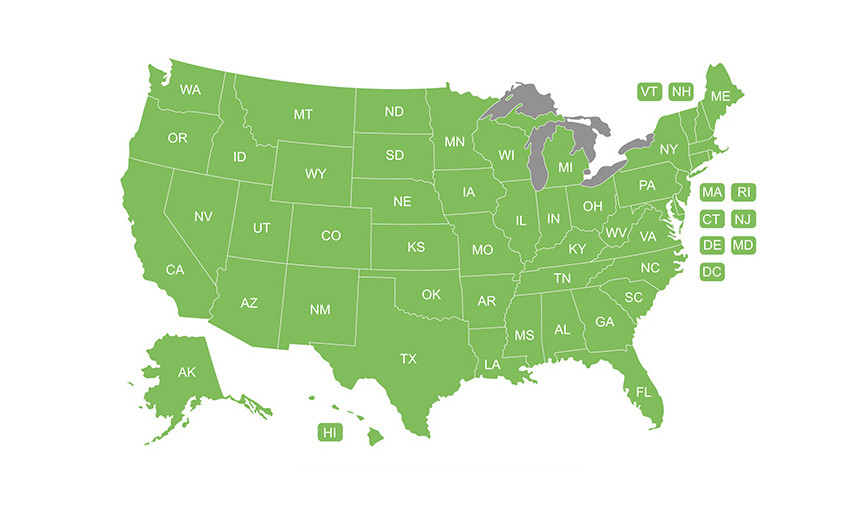
Funding for EV charging comes from more than one place: federal programs like NEVI, state-level pools such as CALeVIP, regional and local grants, and increasingly, and utility incentives for site hosts installing charging infrastructure. Rules and availability shift across all of these on a regular basis.
Our funding and policy team tracks these programs at the federal, state, local, and utility level so property owners don’t have to. Whether you’re evaluating chargers for a hotel, a retail lot, or a fleet depot, we can point out potential funding sources that might apply to your property.
EV charging options from BTC POWER for hotels and resorts
BTC Power is a US-based EV charger manufacturer offering several options for Level 2 or 3 chargers. We have a touchscreen and payment flexibility that suits the hotel model for card swipes. Our L2 30-40 Amp Dual Port is an excellent solution for destination locations, such as hotels, offices, factories, or other locations where drivers will be parked for extended periods. Ask about NEVI-compliant products and configurations (National Electric Vehicle Infrastructure). Or, call to ask which chargers and what type of setup will best service your location. Contact us today.
Frequently Asked Questions
Do hotels have EV charging stations?
Yes. Most major hotel brands now offer EV charging at a significant share of their US properties, primarily Level 2 chargers for overnight guest use, with fewer properties offering DC fast charging. Coverage varies by brand and region, so checking a specific property’s amenities before booking is still the most reliable approach.
Which hotel brands offer EV charging?
Marriott, Hilton, IHG, Hyatt, Best Western, Wyndham, and Choice and other national or luxury brands all now offer EV charging at a meaningful number of properties. Most are searchable directly through the brand’s own booking site or app filters. Full-service and upper-midscale brands have moved fastest; independent and limited-service properties still lag behind.
Is EV charging free at hotels?
It depends on the property. Some hotels offer charging as a complimentary guest amenity, others charge a per-session or per-kWh fee, and some bundle it into a paid valet service. Guests should confirm cost and availability directly with the property before arrival, since policy varies even within the same brand.
What should hotel owners look for in an EV charger?
Outdoor-rated durability (NEMA 3R enclosure), verified uptime backed by operational data rather than a spec sheet, and a modular design that allows adding capacity later without replacing the whole unit. For any property planning to charge for sessions in California, CTEP certification is also required.
About the Author: Caitie Romano, MA