
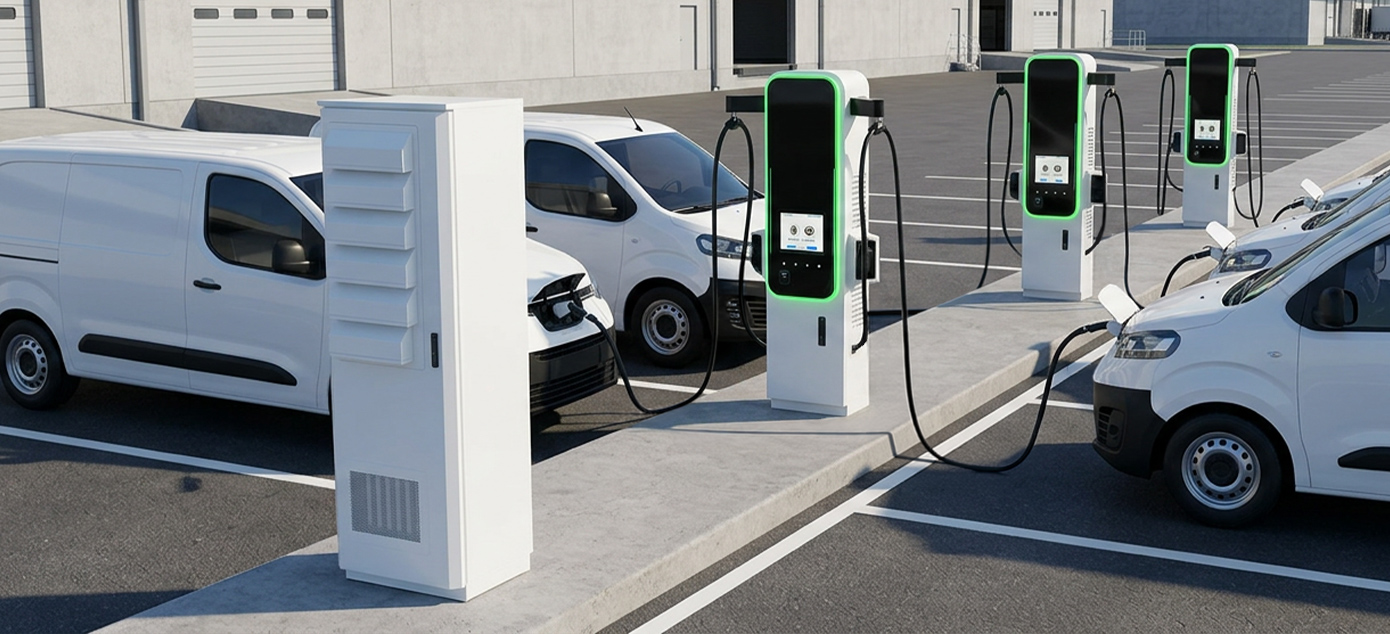
Introduction: One Cabinet, Many Dispensers. The Split-System Idea
Not every DC fast charging site is built the same way. A single-bay coffee shop lot has very different needs than a five-bay retail plaza or a fleet depot with a dozen vehicles idling overnight and requiring a full charge for the next day. Different use cases help illustrate the value of a power cabinet. A power cabinet centralizes power conversion in a single enclosure that feeds multiple dispensers. This shifts the architecture of an EV charging installation in a simple way with an oversized impact on the cost, footprint and scalability.
What a Power Cabinet Does in a DC Fast Charging System
A DC power cabinet houses the power electronics, including rectifiers, power modules, cooling systems, and controls, that convert AC grid power into DC output. Rather than bolting that hardware to the dispenser the driver plugs into, the cabinet sits off to the side (or even indoors, in a back room or utility closet) and distributes power to two or more dispensers through cabling. The Gen 4 360 kW Power Cabinet from BTC POWER, for example, powers in 90 kW increments up to 500 feet away from the dispensers.
This is the core difference from an all-in-one DC charger, where the power electronics, user interface, and connector all live in a single unit. All-in-one chargers are simple to deploy for a single stall. A split system decouples the power-conversion hardware from the customer-facing dispenser, letting one cabinet’s power output be shared and rerouted across more than one dispenser when space considerations dictate a smaller footprint.
When Split Systems Make Sense
Split systems earn their keep at scale. For a single dispenser, an all-in-one unit is often the more economical and lower-complexity choice. But once a site plans for five or more dispensers, multi-bay parking configurations, or a phased buildout with plans for more stalls at a later phase, a cabinet architecture starts to pay for itself, helping sites avoid the expense and upheaval of replacing existing infrastructure.
Fleet depots are a good example: vehicles don’t all draw peak power at once, so a handful of cabinets can serve a large bank of dispensers efficiently. Retail and highway corridor sites with multiple bays benefit similarly, especially where curb space or conduit runs are tight and a smaller dispenser footprint matters for site design.
Other applications include:
- NEVI corridor stations: Program requirements include at least four DC ports with 150 kW-per-port builds. A single cabinet feeding four dispensers hits the port count without duplicating power conversion hardware four times over.
- C-store and fueling station lots: Traffic patterns vary with a sudden wave, then some downtime (like a line of cars off the highway and nothing for 10 minutes). A shared power pool absorbs that spike instead of sizing every dispenser for a random peak.
- Delivery and Class 8 fleet depots with staggered return times: Unlike overnight school bus depots, delivery vans and Class 8 trucks often cycle back to a depot at different times throughout the day and need a quick charge before returning to duty. A cabinet can shift power toward whichever vehicle is closest to its next departure
- Phased multi-family or workplace lots: Property managers might start with two or three stalls and add more as tenant or employee demand grows. A cabinet allows properties to add dispensers and grow with demand without overhauling electric infrastructure each time.
How Dynamic Power Sharing Allocates Output Across Dispensers
Dynamic power sharing, not consolidation, is the real advantage of a power cabinet. Rather than fixing a set kW allocation per dispenser, the cabinet’s controls continuously monitor demand across all connected dispensers and shift power to wherever it’s needed most at that moment.
If only one vehicle is plugged in, it can draw a larger share of the cabinet’s total output. As more vehicles connect, the system rebalances output across all active sessions in real time, based on each vehicle’s charging curve and state of charge. The result is better utilization of the site’s total power capacity, and less need to oversize infrastructure for a peak scenario that rarely happens.
Power Cabinets Cost Considerations at Scale
The economics flip depending on scale. For one or two stalls, individual all-in-one chargers usually have a lower total cost, since there’s no shared infrastructure to size or install. But per-port cost trends the other way as bay count grows. A split system spreads the cost of power electronics, cooling, and grid interconnection across many dispensers, so each additional bay costs less to add than a standalone unit would.
Phased sites benefit too. Operators can install the cabinet and initial dispensers now, then add dispensers later as demand grows, without duplicating power conversion hardware each time.
How BTC POWER’s DC Split System Power Cabinet Fits This Model
BTC POWER’s Gen 4 split system architecture reflects this approach directly. The Gen 4 360 kW power cabinet centralizes power conversion and pairs with public or fleet dispensers to deliver dynamic power allocation across connected bays. Key features of the architecture include:
- Centralized 360 kW power cabinet that feeds multiple dispensers instead of duplicating power electronics at every stall
- Dynamic power sharing across connected dispensers, so output shifts to wherever demand is highest at any given moment
- Smaller dispenser footprint, which helps operators make better use of limited or expensive site space
- Modular, future-proof design, allowing dispenser count to scale as a site’s traffic grows without replacing existing infrastructure
- Buy America compliant options, relevant for projects tied to federal and state infrastructure funding
Together, these features make the Gen 4 platform a practical fit for the multi-bay, phased deployments where split systems make the most sense.
Matching Architecture to Bay Count, Not the Other Way Around
The right charging architecture isn’t a matter of preference. It’s a matter of site size and growth plans. Small, single-stall sites are usually best served by all-in-one chargers. Larger, multi-bay, or phased deployments are where power cabinets and dynamic power sharing start to make sense both financially and for operations. The goal is to match the architecture to site use. Planning an installation? We can help, from pointing out funding options to selecting the right system that fits your unique site specifications.