The most common mistake in EV charging infrastructure isn’t buying the wrong charger. It’s buying the wrong charger for the wrong reason — usually because speed gets treated as the primary goal when the actual goal is something more practical: vehicles that are ready when you need them. Almost equal importance is keeping energy costs under control so they don’t undermine the economics of going electric in the first place.
Level 2 and Level 3 charging installations aren’t in competition with each other. Each offers a solution or a different approach to specific problems. Evaluating your situation helps ensure the proper selection of a charging installation that yields the best long-term total cost of ownership while getting vehicles into operation at a pace that meets your goals.
Virtual Showroom
See all BTC POWER EV Chargers
The Variable That Matters Most: Dwell Time Difference Between L2 and L3 Chargers
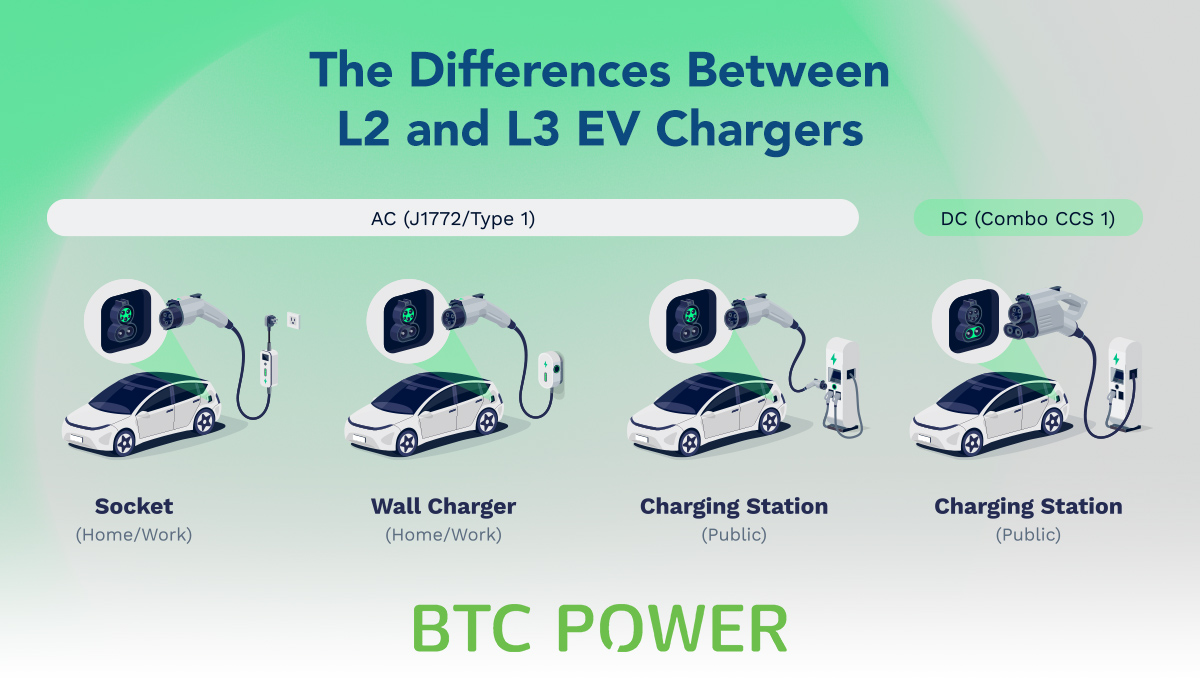
The first step in deciding between the two chargers is to consider the available charging time based on how long a vehicle is parked, or “dwells”. L2 charging — typically 7 to 19 kW — makes sense wherever or whenever a vehicle is parked for hours. This can mean personnel at work, vehicles parked at hotels or homes, as well as fleet vehicles parked overnight. L3 DC fast chargers, which can deliver 50 to 350 kW or more, are designed to do as their name suggests: deliver a fast charge, within 20 to 45 minutes, and then move on to the next vehicle.
The dwell time impacts individuals as well as fleets. For example, a single driver who parks in a garage overnight has a longer dwelling time than a traveler on the road at a quick lunch stop. In addition, a school bus depot houses its vehicles overnight for a minimum dwell time of 12 hours. An L2 unit at 19.2 kW will fully charge almost any battery in that timeframe at a fraction of the cost of a DC fast-charging station. Installing an L3 charger in that scenario is not an upgrade to your infrastructure. It is overbuilding it — and paying for speed you will never use.
Compress the dwell window to three or four hours, and the preferred EV charger changes. A delivery fleet with vehicles swapping shifts midday can’t rely on standard L2 to keep up. That’s the case for purpose-built solutions like BTC POWER’s split system dispenser, which is designed for a single 360 kW power cabinet feeding up to eight vehicles, hitting the medium-dwell window that standard L2 undershoots and full DC fast charging over-engineers.
Compress the dwell window further — to 20 or 30 minutes — and L3 stops being one choice and becomes the only choice. Highway corridors, high-turnover rideshare staging, and transit buses between routes aren’t choosing between an L2 and an L3 DC fast charger; they’re choosing the DC fast charger that best serves their needs.
For some operators, short dwell time isn’t a constraint to work around — it’s the entire operating model. L3 is the clear choice for:
- Interstate travel plazas and highway rest stops
- Rideshare and taxi staging areas
- Transit agencies turning buses between routes
- Retail destinations with high-turnover, short-dwell traffic
- Emergency or backup charging for fleets with unpredictable return schedules
- For any of these operators, the first step is finding the configuration that handles their peak load.

Looking to Maximize Your Investment?
Learn how BTC POWER’s customization options help you choose between L2 and L3 EV Chargers
The Cost Reality Nobody Talks About Until the Utility Bill Arrives
L2 EV charger infrastructure is dramatically cheaper — often by a factor of 10 to 20 times when you account for the full project. A commercial L2 unit typically runs from $1,500 to $5,000 installed. A DC fast charger, once factoring in equipment, electrical service upgrades, utility interconnection, and civil work, can run $50,000 to $150,000 per port. For a business trying to offer charging as an employee benefit or customer amenity, L2 is almost always the rational choice.
Those ongoing costs are where L3 EV charger economics get genuinely complicated. Utility demand charges — billing structures based on peak 15-minute power draw rather than total energy consumed — can make a DC fast charger that sits idle most of the day surprisingly expensive to operate. Managing that exposure requires energy management software that stagger sessions and delay charging the until off-peak windows. It works, but it adds cost and complexity that L2 deployments.
There’s also the infrastructure question upstream of the charger itself. L2 chargers run on standard commercial power. L3 often requires a medium-voltage service upgrade — a utility transformer project that can take months and cost tens of thousands of dollars before a single charger goes in the ground. For older buildings, rural sites, or multi-unit housing, that alone can make L3 EV charger installations challenging.
However, figure in a high turnover and now a DC fast charger has the opportunity to pay for itself. A DC fast charger serving 40 or 50 sessions a day at a busy travel plaza generates enough throughput that capital and demand charge costs amortize quickly. And for operators running large sites, managed charging software isn’t just a cost-mitigation tool — it’s a revenue-optimization tool. Staggering sessions to off-peak windows, pre-conditioning vehicles, and automating charge scheduling can meaningfully reduce operating costs while maintaining the fast-turnaround availability the site depends on. The complexity is real, but so is the payoff.

Battery Size Is Growing — But That Doesn’t Mean L2 Is Going Away
As automakers push battery ranges above 300 miles, battery packs in trucks and commercial vehicles are hitting 100 to 200 kWh. The intuitive response is that bigger batteries require faster charging. The reality, however, is more complicated.
Most EV drivers don’t let their batteries run down and recharge them the way they would a gas tank. The dominant pattern is topping off daily from whatever state of charge the vehicle returns with — often 60 to 80 percent remaining. If a vehicle drives 40 miles a day and returns home at 75 percent charge, a 7.2 kW L2 charger restores that energy in two or three hours, regardless of total pack size. Bigger batteries, surprisingly, often reduce daily charging demand because range anxiety diminishes and drivers no longer feel compelled to keep their batteries fully charged. Additionally, L3 EV chargers can add power to an existing system.
As more electric vehicles enter the market, the uses – fleet vehicles with large packs and tight overnight windows, electric semis and heavy-duty work vehicles, and multi-unit housing where shared ports must serve more residents. The industry’s response isn’t that L2 is becoming obsolete — it’s that L2 is evolving. Commercial installations are moving toward 19.2 kW as a baseline, and a middle tier in the 20 to 80 kW range is emerging for applications that overnight L2 can’t quite cover.
Compare the Differences Between L2 to L3 EV Chargers
| L2 | L3 | |
|---|---|---|
| Current Type | AC (Alternating Current) | DC (Direct Current) |
| Power Output | 3-19 kW | 50-350 kW |
| Charge Speed | 10-30 miles of range per hour | 100-200+ miles in 15-30 minutes (depending on kW and battery size) |
| Connector Type | SAE J1772 | CCS1, CHAdeMO, NACS |
| Install Cost | $500-2500 | $50k-300k |
| Grid Impact | Low | High |
| Revenue Generation | Low | High |
| Best for | Locations with long dwell time – hotels, overnight depots, offices, and multi-family dwellings | Locations with high turnover – C-store and gas stations, entertainment complexes |

White Paper
The Road to Interoperability: Standardization and the Future of EV Charging Networks
Get the full white paper for more insight on EV charger interoperability.
The Strongest Deployments Usually Include Both L2 and L3 EV Chargers
The difference between L2 and L3 charger installations is useful for individual sites but can be misleading at the portfolio level. The most resilient charging infrastructure tends to deploy both, matching charger type to actual use case. A large fleet depot might run L2 or fleet-dispenser systems for vehicles with predictable overnight schedules and keep L3 capacity available for vehicles that return mid-shift with a tight turnaround or for service to delivery trucks bringing essential supplies. A workplace installation might anchor on L2 for commuter volume and add one or two DC fast chargers for drivers who arrive depleted.
Choosing Between L2 and L3 EV Chargers Means Starting with Your Operations, Not the Spec Sheet
- How long are your vehicles parked – not in the ideal schedule, but in the real one?
- What does your electrical infrastructure look like today, and what would it cost to upgrade?
- How many vehicles are you charging now, and how many in three years?
- What is your energy rate structure, and do demand charges apply?
Those questions have specific answers for every site, and the right charger configuration follows directly from them. BTC POWER builds charging solutions across the full spectrum — from high-efficiency L2 dispensers to high-power DC fast chargers built to NEVI standards and manufactured in the USA. The goal isn’t to sell you the fastest charger. It’s to match the right solution to your actual operation. If you’re working through these decisions, we can help you. Start your conversation today by contacting us.
About the Author: Jack Hepsen